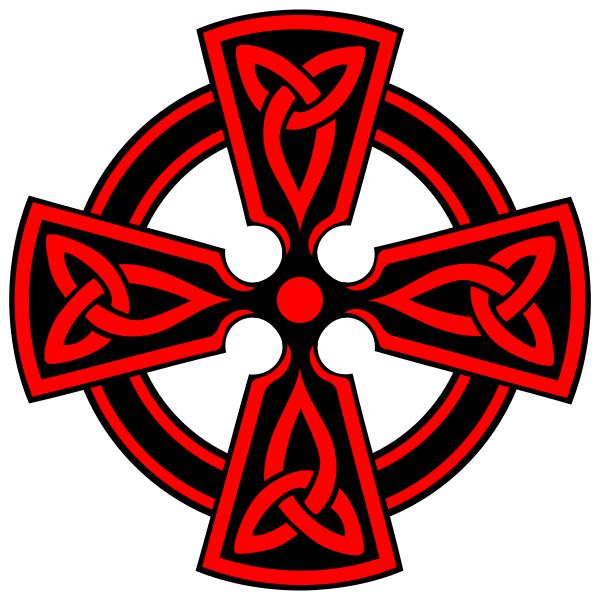
The Celtic Cross: A Symbol of Faith, Heritage, and Fraternity

The Celtic Cross is one of the most recognizable symbols of Celtic culture, blending ancient pagan traditions with Christian spirituality. Its design, a Latin cross intersected by a circular ring, has endured for centuries and continues to inspire reverence and pride across Ireland and beyond. While its precise origins remain uncertain, historians trace the symbol back to the early Middle Ages, when it appeared on monumental stone crosses in Ireland, Scotland, and other Celtic lands.
The circle, often referred to as a halo or nimbus, adds a profound layer of meaning to the cross. It has been interpreted as a representation of eternity, unity, and the interconnectedness of all things. Long before Christianity reached Celtic regions, the circle was associated with the sun and its life-giving power. Ancient Celts used circular motifs to honor the sun god, and when Christianity spread through Ireland, missionaries adapted the design to incorporate the cross, symbolizing the crucifixion of Jesus Christ. This fusion of traditions allowed the Celtic Cross to serve as a bridge between old beliefs and new faith.
Throughout history, the Celtic Cross has evolved in both form and meaning. In medieval times, it was carved into towering stone monuments known as high crosses, often decorated with intricate knotwork and biblical scenes. These crosses were erected at monastic sites and served as teaching tools for communities, embodying both artistry and devotion. Centuries later, during the Celtic Revival of the 19th century, the symbol gained renewed prominence as an emblem of Irish identity and nationalism.
Today, the Celtic Cross remains a powerful cultural and spiritual icon. In Ireland, it is commonly found in cemeteries, on gravestones, and at ancient monastic sites such as Clonmacnoise and Monasterboice. It is believed to offer protection and serve as a connection to the divine. Beyond Ireland, the symbol has spread globally, appearing in jewelry, art, and architecture, embraced by communities of Celtic descent and admired for its intricate beauty.
The Celtic Cross endures as more than a religious emblem. It is a timeless fusion of pagan and Christian traditions, a work of art, and a cultural marker of resilience. Whether standing tall in stone at historic sites or worn as a personal symbol of faith and heritage, the Celtic Cross continues to embody the unity, eternity, and spiritual depth of the Celtic people.